The Body, the Bar, and the Odyssey
Hundreds of applicants in line outside the test center, wringing their hands like wet scarves. In an hour, we will be sitting down to take the California bar exam—an exam we have prepped day and night for during the past several months. For two long days—six and a half hours of written essays the first day, seven hours of multiple-choice questions the next—we will be answering questions from memory on fourteen different legal subjects spanning thousands and thousands of pages. It is likely the most difficult exam we will ever take in our lives.
Everyone is quiet and pale-faced, muttering mnemonics and flipping flashcards as they pace stiffly back and forth. The line crawls forward, heat beating down on our teeming bodies and rendering us faceless, a blur. Like pigs to the slaughter, my friend F. says grimly, running his fingers through his dark curls. Beside us, other applicants repeat to each other: It’s a privilege to take the bar, it really is!, a slight quiver in their voices betraying the brightness of their verve.
My friend B. was an academic weapon at Stanford Law School, always sweeping in prizes for being at the top of the class, but even he looks nervous today, eyes blank with the look of absorbed assessment I recognize as preparation for battle. He still recovers a moment of blasphemous mirth when he sees my face: I talked to God yesterday, Esther, he calls out merrily, and he told me you were gonna fail!
I am furious. Fuck you, I say, and F. bursts out laughing: Whoa, I think that’s the first time I ever heard Esther curse at anyone. I squat down on the hot concrete and mutter, I can’t fail. If I fail, I’m moving back to Korea and getting facial reconstruction surgery so no one will recognize me. F. and B. burst into laughter as the line continues to wind through the door.
Then, the exam. The doors close. A multitude of fingers hit hundreds of keyboards, a downpour of hammering rain. Pencils pool angry dark spots on reams and reams of paper. Circle. Fill. Repeat. After a hundred questions, my head begins to swirl with migraines. Applicants rush out quietly in the middle to hurry to the bathroom, to urinate or splash water on their faces or throw up. I will later learn that at another test center, an applicant collapses mid-exam and suffers brain injury as a result.
At long last, the proctor rises, ominous prophet of an unseemly rite of passage, and gazes solemnly at the sea of waiting faces. The exam is over, she thunders. You may leave the room.
A shocked pause. Then a wave of cheers ripples, then roars through the room—long months of sleepless nights and hastily swallowed meals and anxiety erupting in a terrible, joyous explosion of noise. Our microcosm has shattered. The exam is over. The war is over, and we can go home.
⋆✴︎˚。⋆
Home. But where is home? During lunch break at the test center, I murmur sadly, I just want to see my mom and get a big hug, and B. rolls his eyes and quips, Well, better go back to Korea then, ’cause you’re not getting that from me!
When I walk out of the test center, B. has already left to join his girlfriend on a trip to Peru, and F. will return home to receive a hero’s welcome from his girlfriend and family. As the crushing pressure of the exam finally lifts from my shoulders, a cold, beaded string of loneliness trickles in.
I walk out from the crowd, eyes glazed, lips resinous with silence. J., a tennis athlete I became friends with last year during my summer internship in the city, has been kind enough to let me stay with him after the bar while I look for housing in LA, and F. drops me off near his place.
F. and I are both very tired and a little depressed, and are quiet on our way there. Lawyer after lawyer leers down at us on billboards as we drive past: America’s largest personal injury firm! SIZE MATTERS. F. shakes his head, murmuring reflectively, If all these idiots passed the bar…
When we meet, J. is warm and shy and full of welcome. We have not seen each other in nearly a year, but he has been a patient listener of my complaints during my long nights at the law library, given me pep talks over the phone when I felt close to panic attacks.
During the bar, it was comforting to speak to someone whose devotion was entirely to the demands of the body—the arm’s lithe swing, shoes that would wear out in two weeks from footwork, the discipline of movement. Whereas most of my days were absorbed hunched over a desk, squeezing eye drops into strained retinas and wrestling with wordplay and abstractions.
In the evening, J. grinds ginger and garlic to make me bulgogi and oi muchim, and when he hands me these home-cooked, familiar dishes, saying, I wanted to give you a little taste of home to celebrate all your hard work, I feel tears gush into my eyes. His stark whale-blue eyes rest on me kindly as I dissolve into his arms and whisper, Thank you. I never want to go through that again.
After, the nightmares flashing through my sleep. In one dream, I wake up in a cold sweat convinced that I completely missed an entire section of multiple choice questions, and left nearly forty questions unanswered. In all of them, doctrines teem through my memory like spiders, wills and trusts tangling like masses of silk webs at the bottom of my brain.
If everything is physical, F. used to muse, it’s interesting how studying for the bar actually changes our brains. It’s like we have all these tiny workers chipping away the facts we need to memorize into our heads, although the engravings sure didn’t go deep.
My mother tells me I will forget it, the sleepless nights, the hovering panic, the constant and piercing inadequacy, just as she forgot the pain of labor as soon as she witnessed my howling face.
F. modifies the metaphor to befit our agonized wait for the results: It’s like having a baby, he says, but then they snatch the baby away from you for the next few months, and you don’t even know if it’s alive or dead…
⋆✴︎˚。⋆
The law is a corpus of knowledge that encourages what philosopher Drew Leder calls corporeal absence. In studying and applying the law, our bodies recede from our conscious experience: even as we read and form words that impact the bodies of others, the process requires us to remove ourselves from awareness: to focus on semantic justification over the specific sensation of our limbs flexing, our fingers typing, our breaths constricting in our chests. The law rewards those who best remove themselves from their own embodiment.
And yet the costs of studying for the bar manifest in ways inherently physical. I just keep buying new underwear because I don’t have time to do laundry, a classmate says ruefully. I slept for two hours yesterday, says another, gesturing towards the dark circles ringing his eyes.
After the bar, I am exhausted in a way that feels bone-deep, residual, and for weeks afterwards I feel both light and strangely inflexible, like a wax seal that has cooled in the imprint of the stamp’s firm pressure. Without an eight-hour list of study tasks to complete, I eat long leisurely breakfasts, flexing my legs and watching the sun paint light on the kitchen tiles. I walk to a local cafe without the weight of bar textbooks sloughing off my shoulders, and chat cheerfully with a stranger who wants to know if the cream puffs are any good. I slow down. I breathe. There is no hurry.
J. knows how much I love the ocean, so one afternoon he drives us down to the beach. He is not particularly fond of water, so he stays on the shore, kicking sand at the ravenous seagulls that swoop down towards our potato chips. I run back and forth by myself in the water, plunging into the cold shock of the foamy waves, and laugh with delight.
Happy? J. asks, watching me.
I feel the spindrift hit my face, and turn to him, nodding. His eyes crinkle into a smile. We have agreed long ago that we should not be in a romantic relationship, but sometimes his kindness feels so close to love, I can hardly tell the difference.
The sunset floods everything warmly orange, even the waves that crash warmly at our feet. J. carries my sequined sandals, and they look so small in his large hands, solid and blunt as if carved out of driftwood. I follow him, my footsteps making wet patterns on the hot cement. Sometimes, even in moments when J. is softest, I feel so lonely I think I could cry and cry and cry.
How strange life is.

⋆✴︎˚。⋆
The week after the bar is spent in a whirlwind of dislocation and transportation: house tour after house tour, trying to find anywhere that would accept a student fresh out of school without a credit report to her name, packing, unpacking, and packing again. I finally find a new apartment, a ten-minute drive from my office, and sign the lease with a flourish. My life as a student is over—my new life in LA is set to begin.
Then, at long last: Korea. If start and startle spring from the same etymological root, going back to the city I know best always feels like returning to something new. I am startled by what I used to take for granted. I receive the courage to begin anew.
The first night I spend at my parents’ place, my mother tiptoes in to kiss me goodnight. When she wraps her arms around me, I feel tears well up in my eyes. I am so happy to see her, touch her, the rare luxury of being-with—not through a smartphone camera over video call but in all her softness, her warm scent of freshly cooked rice, her large radiant eyes so brimming and hopeful. It hurt searingly to be caressed so tenderly by someone I felt safe with, someone who loved me without restraint.
Skinship: one of my favorite words, a foreign-adjacent word adopted into the Korean vocabulary. Hugging my mother makes me feel like my body is no longer foreign to me, and I exist as more body than shadow, more grounded and tangible in the world I live in.
⋆✴︎˚。⋆
Loving my mother has made me suspicious about our relationship to the body, its potential as a site of suffering. A life of constant physical and mental stress made manifest: all those years of skipping meals and working to keep food on our table and give us girls an education resulted in an early onset of rheumatism, knee effusion, severe glaucoma, frozen shoulders. Her health has grown more robust now, but I still remember the way my heart ached when helping her up a single flight of stairs, and watched her whole body tremble.
Winter was more dangerous, when she rode her motorcycle into the bitterly freezing winds, wheels skidding on black ice as she navigated the narrow roads from one tutoring house to another. But summer was harder to bear. Sometimes I rode in the back seat on hot days and felt my skin singing with pain at every traffic stop, when we hovered beside humungous green buses and wheezing automobiles, all radiating heat from their steel bodies in angry waves that we experienced directly on our exposed flesh. Her body seemed like a cage of pain and privation, narrowing the scope of her arching spirit and spiritual aspirations.
Yet how can I separate my mother from her body? Her stout dark fingers, which flew across the polished piano keys with such ineffable grace and coaxed the loveliest melodies from the instrument’s depths. The liquid softness of her skin, into which I buried my face and inhaled deeply, inhaling the clean baby scent which lingered on her even after hours of hard work outside. Her heartbreakingly lovely eyes that shone so beautifully when she smiled, and grew ever larger and more radiant as age sloughed off the youthfulness of her features. Every time I saw my mother in Korea again after a long time away, I would cling to her hands and hug her close as if I were terrified of letting go. Who is my mother without her body? How can I express my affection for her if not through touch—my arms around her waist, my hand stroking hers tenderly, my fingers translating our sensory memories into this hall of written mirrors?
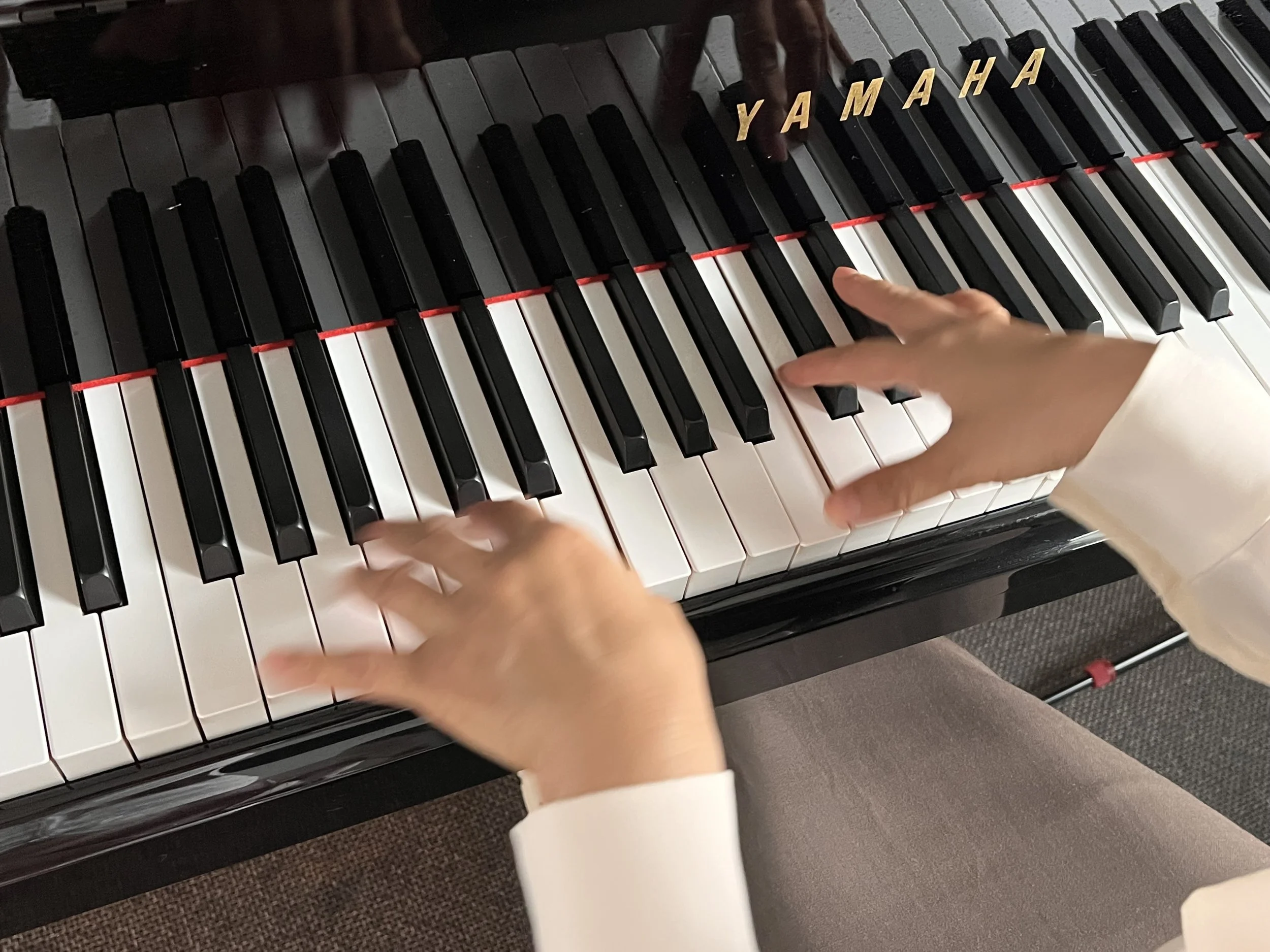
my mother’s hands playing the piano
The writer David Hayden speaks of the relationship between the body and writing, which is for me to say the relationship between the body and loving: “That which is in the bone, in the body dark, in the body’s flows and sparks, can be made available through the words that are found by noticing. What comes in through the ear, the eye, the skin, can be rematerialized as words for the reader to make sense with, to live with, to remember or forget.”
What I know of my mother I know through the ear, the eye, the skin. I write down this record of the body to remember her. I write to remember.
⋆✴︎˚。⋆
To love my home city, too: an incarnational experience.
I can talk about Seoul and dream about Seoul, but nothing can replace the specificity of its sensory experience: feeling the bubbled yellow safety blocks under my feet, squinting up at the cherry blossom shaped streetlights dancing across my face, smelling the sharp pungent drift of what the stream carries, hearing the night trains roar overhead, mosquitoes biting at my ankles, willow trees rustling softly in the wind. Listening to the voices of the familiar church congregation swell and thunder together in praise, joined by the garbled laughter of new babies born while I was away.
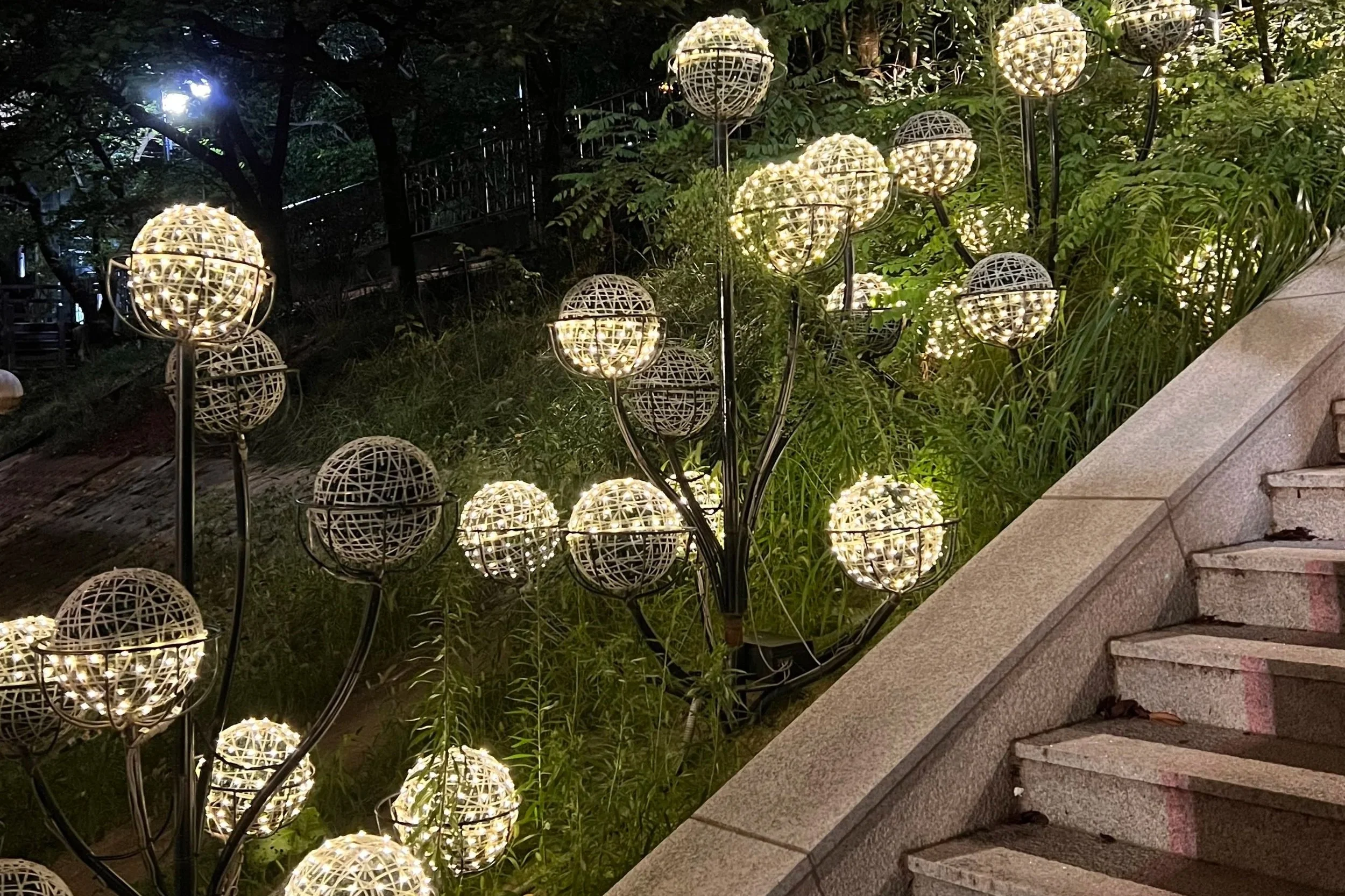
I meet with J.S., a childhood friend. We walk for hours through the streets and parks and gardens of Seoul at night, like we used to every week when I lived in Korea, our footsteps bridging the gulf between past and present, and the many years that Rapunzeled their hair grow insignificant, a dream. Korea is the only reality. Exploring the small marvels of the streets that have changed their faces since I saw them last, we speak quietly about the respective landscapes of our own hearts.
In America, I feel like I’m walking on a bridge made of planks of wood on a roiling ocean, I tell him. We reach a slab of pavement where an artist has painted currents of whitewater rapids on the street, and I jump from plank to imaginary plank, stretching my arms out for balance. I’m trying to cross the ocean on this bridge, but I feel so afraid. I have no idea when it’ll all break apart and I’ll be whirled away by the waves.
J.S., ever the optimist, grins and holds out his hand to help me across.
Even if it does, he says, I know you’ll hold onto the broken planks and survive the storm somehow. You always have.
⋆✴︎˚。⋆
In Korea, our church members gather to watch Nolan’s The Odyssey together, and immersed in the theater’s rich flood of sound and color, I am struck by how powerfully the film has translated the physicality of the time-worn, far-off narrative. What impresses me is not the grandeur of the ambitious themes, nor the warring of the gods, but rather, the frailty and stink and messiness and glory inherent in these supposed legends. The men drowning and gagging in their own shit for days while waiting in the belly of the Trojan horse. The horde of wasp-bright armored soldiers pouring into the impregnable city and ravishing it to a chorus of screams. The luxurious gleam of Penelope’s majestic black braid against her royal robes as she strains to make her yearning for Odysseus visible through the craft of her hands, weaving and pulling apart his funeral shroud each day.
In particular, I am moved by the scene in which Odysseus finally awakes from the long dream of the lotus flower and remembers his way home—which requires him to submit to the punishment of Poseidon. What seemed merely a glancing reference in the original narrative becomes real, becomes almost unbearable, when shown in all its physicality. Poseidon’s wrath against Odysseus is made tangible by the wind whipping mercilessly at his strained muscles and haggard cheeks. For long, somber minutes, the audience is immersed in the water with him; we watch him gurgling and gasping for breath, his silent transformation from a prideful and interminable struggle with the gods to a humbler acceptance of his fate. His body paying the consequences of this acknowledgment, this acceptance: water gushing over his face, his body racked on his makeshift raft, suffering and flailing and praying with his whole body. An embodied atonement.
Despite being situated at a time when everyone believed the gods walked amongst men, Nolan’s The Odyssey resonated powerfully with me because, like in our present lives, the gods are rarely explicitly shown—when Athena makes her appearance, it is unclear whether she has truly taken on the form of a young girl or if she is simply a figment of Odysseus’s latent guilt. Instead, it is with their bodies that the characters attempt to understand the workings of the divine: Odysseus’s men questioning whether each wave that slams into their ship is a sign from Poseidon; Odysseus’s men slaughtering the sun god’s animals because they cannot see the sun god, but they can feel their own devouring hunger.
In Christianity, too: we find God in the physical—the flame that does not burn, the water that quenches our thirst flowing from the rock, the strange food that falls like rain and satisfies our hunger. Cole Arthur Riley notes that “when we neglect the physical, it inevitably suffocates the image of God who ate, slept, cried, bled, grew, and healed.”
⋆✴︎˚。⋆
I have never been a good liar, but my body is also quick to betray what language has been built to protect. I blush easily. My eyes sparkle when someone I love walks into the room. Anger brings waves of stress through my limbs, my heart, my stomach, upending my menstrual cycle and raising red welts on my skin.
After we finish the movie, we go to a board game cafe, and one of the games is a round of “Who Stole My Cheese”: a mafia-type game where the mouse identified as the “cheese thief” must bluff her way through rounds of inquiry. When we opened our eyes to begin the game, a new church member sitting across from me (we had only met each other for the first time that week) immediately exclaimed: “I think Esther is the cheese thief. Her expression’s completely different from the last few games, she has determination written all over her face!”
My body immediately giving away my secrets. My expression reflecting emotion faster than thought can formulate speech.
⋆✴︎˚。⋆
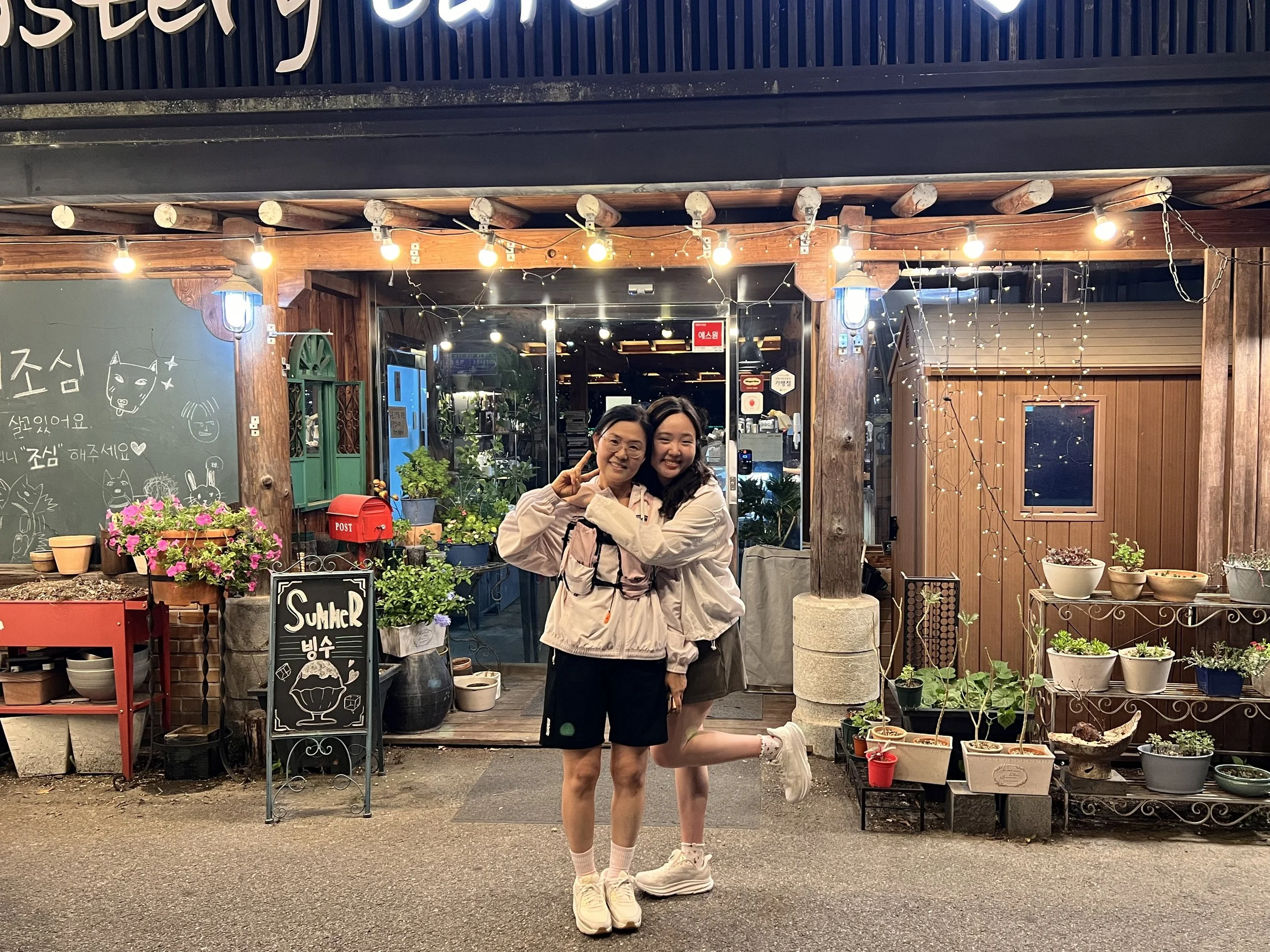
Another new and wonderful startlement: my mother has taken up slow jogging as her new hobby. She runs 5 kilometers every day, rain or shine, and I join her in her patient circles around Baekun Lake, watching the buildings throw shimmering yellow sequins on the glass surface of the water. By the time we have finished running, our faces are wet with sweat, and I have to stop to walk several times in the middle, but Mother never pauses. She jogs slowly but steadily over the bridge, the pavement, the grassy fields.

It moves me to watch her speeding over a significant distance, her body compact and energetic in the pale pink windbreaker and running belt she has strapped over her shoulders. How a body that has caused her so much suffering has become a less painful vessel for her beautiful soul. She tells me that whatever hardships befall our family, befall our church, running clears all the troubles from her head and lifts her spirits. Running makes her want to live.
⋆✴︎˚。⋆
Immigration is strange. It clarifies the body and makes it legible and palatable to the government by virtue of several flimsy pieces of paper: at the same time, the absence of such documentation can erase my existence despite my physical presence. I slide my documents under the glass grille at the port of entry, and under the confirmatory nod of the inspections officer, my body acquires legitimacy. I move from not there to there. From a land of legal fictions and in-betweens to presence.
It is strange to think that I was in Korea just a few weeks ago, experiencing all these new memories with old and beloved faces, and now my body is here in America, navigating its way through the city of LA. My body is no longer there, but it carries the memory of the ear, the eye, the skin. I write what the body remembers.
⋆✴︎˚。⋆
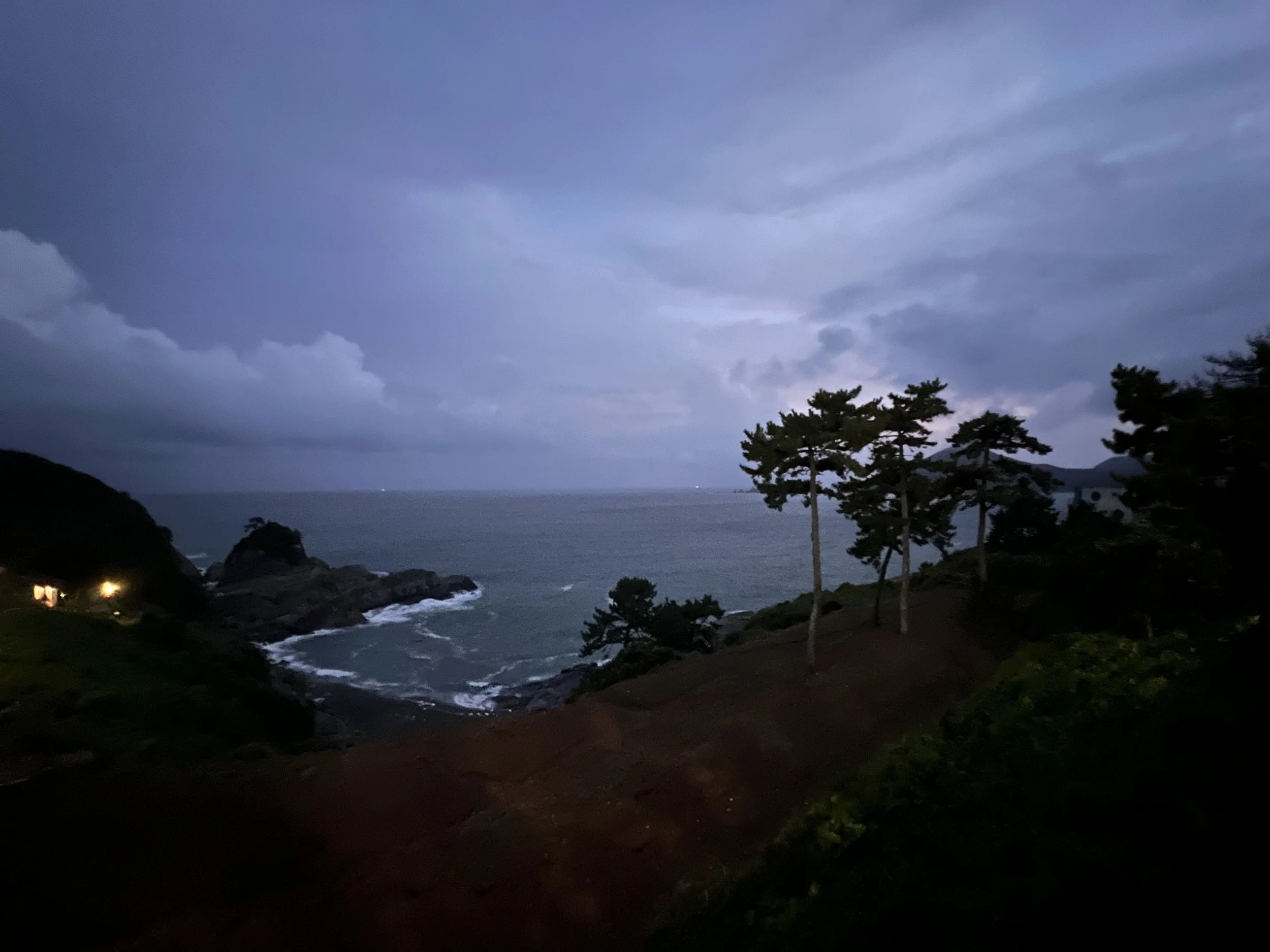
Shortly before I left Korea, we went to visit my grandmother in the Jinju province, and drove to a nearby province in Geoje. Geoje is located directly beside the ocean, so we clambered to the top of what they called the Hill of the Wind. It was a gray cliff strewn with thousands of black pebbles, so that every cold wave withdrew with a harsh sussurus as it clung to the jagged edges of the various rocks. Atop the hill, standing amid the twisted and graceful Korean red pines, I experienced some of the greatest gusts of wind in my life. Fierce currents of air blew straight at us and across us without rest, our hair flying around our faces, as we fixed our eyes on the horizon and listened to the water hiss as it threw itself again and again on the endless rocks, gathering their sharpness in their infinite embrace.
I stood very still, and the world was darkness and movement and roiling ocean beneath me. The wind flung itself around my body like a whipping flag. During the weeks leading up to the bar and the demands of moving afterwards, I had noticed that I had trouble breathing in deeply, and my chest would often constrict when I inhaled. But standing on the edge of the cliff, feeling the wind pummel fiercely my head and hair, I breathed in with my whole chest without the pain and heaviness I had felt for over a month.
I am no longer standing on the Hill of the Wind, but in a cool, quiet home in Los Angeles, where only the electric fan stirs a wisp of wind and moves my hair across my shoulders. But I remember the strength and power and freedom of that moment. I remember what it felt like to close my eyes in acceptance, and let God roar over me. To give myself over to my smallness, and call my powerlessness, praise.